

The relationship between banks and their clients has long been the foundation of the global financial system. However, in recent years, a discernible shift has occurred, with banks becoming increasingly selective about the clients they choose to lend to.
In their pursuit of a balanced and diversified loan portfolio, banks actively manage concentration risk. This means limiting their exposure to particular sectors, regions, or large clients to reduce the potential impact of adverse events in those areas. Banks are inherently risk-averse entities, aiming to preserve their capital and maintain stable profitability. As a result, they’re now more cautious about lending to clients perceived as higher risk, especially those operating in volatile or cyclical industries or facing financial difficulties.
These practices have left some businesses and individuals looking for sources of funding outside traditional banks. Companies experiencing financial difficulties or going through a turnaround phase may be perceived as high-risk borrowers by traditional banks. However, private credit lenders may see potential in these businesses and be willing to provide the necessary capital for growth or rehabilitation.
For distressed companies, private credit can offer a lifeline, helping them regain stability and profitability. This article isn’t choosing sides—it’s meant to help you understand this financing option, including private credit market growth and what that growth means for you as a borrower.
What is Private Credit?
Private credit is non-traditional lending. It’s one of the fastest-growing segments in the lending landscape, which got a boost when the 2010 Dodd-Frank Act—Congress’s response to the global financial crisis—pushed a lot of risky lending outside the traditional banking sector.
The scale of private credit market growth since then has been hard to overstate: according to the Federal Reserve, the market has expanded roughly fivefold to tenfold since the 2008 financial crisis, from around $300 billion in 2010 to an estimated $2 trillion globally today.

Non-traditional lenders provide an alternative to traditional bank lending and are becoming increasingly popular due to their agility, technological innovation, and willingness to furnish credit in an otherwise restrictive regulatory environment. Unlike banks that adhere to strict lending criteria, private credit lenders have the flexibility to evaluate companies based on their unique financial circumstances and potential for growth. They often take a more holistic approach to underwriting, considering factors beyond just credit scores and collateral.
This allows them to extend credit to companies with compelling business models, despite facing temporary financial challenges or having limited physical assets to offer as collateral.
Private Credit Market Trends Worth Watching
As private credit has grown from a niche corner of finance into a multi-trillion-dollar asset class, it’s drawn closer attention from regulators, economists, and the institutions that supply its capital. That scrutiny is being driven by a handful of private credit market trends:
- Rising defaults among borrowers as higher-for-longer interest rates squeeze highly leveraged companies
- Valuation transparency questions, since private credit funds hold loans that aren’t publicly traded or priced daily
- Growing interconnection with banks, with regulators like the Financial Stability Board warning that private lenders and traditional banks are more linked than they may appear
None of this means private credit is inherently unsound. By most measures, it still represents a small slice of overall business debt, and many of its structural features differ meaningfully from what triggered the 2008 crisis. But it does mean that both borrowers and the businesses who work with them should fully understand this option with open eyes, not just as a convenient alternative to a bank that said no.
Tailored Solutions and Flexibility
Unlike often un-customizable conventional loans, private credit instruments can be tailored to meet the unique needs of borrowers. This flexibility enables borrowers to obtain financing solutions that may not be available through traditional lenders, particularly in niche industries or unconventional projects.
Here’s a snapshot of private credit vs. bank loan options, side by side:
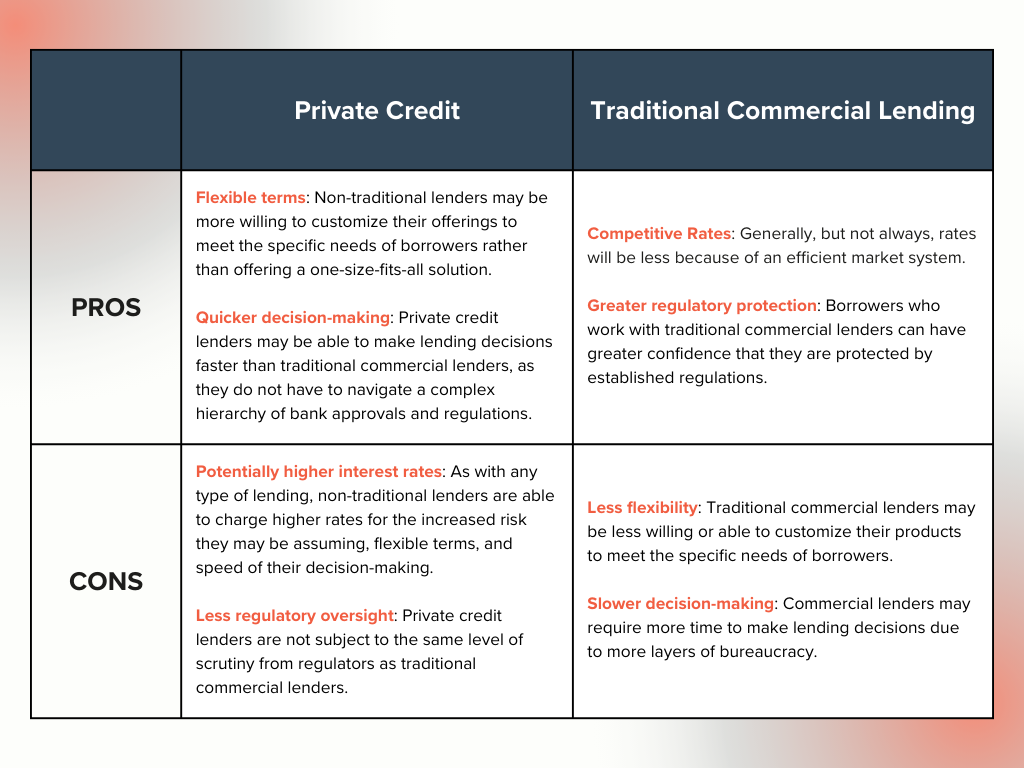
Streamlined Decision-Making
Bank loan approval processes can be lengthy and cumbersome, causing delays for companies needing swift access to capital. In contrast, the private credit market operates with a sense of agility and efficiency. When it comes to private credit vs. bank loan timelines, the streamlined decision-making and faster funding cycles of private credit enable companies to seize opportunities, finance time-sensitive projects, or address immediate cash flow needs promptly.
Lack of Collateral or Creditworthiness
Traditional bank lending typically relies on a client’s collateral and creditworthiness as key determinants of loan approval. If a client lacks sufficient assets to offer as collateral or has a subpar credit history, banks may be hesitant to extend credit due to the increased risk of default.
Companies operating in niche industries or pursuing specialized projects might find it challenging to secure bank loans due to the perceived higher risks or unfamiliarity. The private credit market, however, may be more receptive to these ventures, as its investors often have different risk profiles and a deeper understanding of such industries and projects.
By taking the time to assess the underlying fundamentals and growth prospects, private credit lenders can unlock financing opportunities that don’t fit in a traditional bank’s portfolio.
Shifting Industry Dynamics
Changes in the economic landscape and industry dynamics can significantly impact banks’ lending preferences. For example, technological advancements, regulatory changes, or shifts in consumer behavior may make certain industries less favorable for banks, leading to reduced lending in those sectors.
Private credit lenders excel in crafting tailored financing solutions that cater to the specific needs of businesses. Whether it’s structuring flexible repayment terms, less restrictive covenants, or offering revenue-based financing, the private credit market can accommodate the diverse requirements of companies that don’t fit into the standardized bank lending framework.
Understanding and Weighing Your Options
In a financial landscape dominated by traditional banking, the private credit market stands out as an option for companies that might otherwise struggle to obtain financing. But given the pace of private credit market growth in recent years, that appeal deserves to be weighed with the same discipline you’d apply to any major financing decision—not treated as a shortcut around it.
Regardless of which type of lender you choose, you still need a viable business plan that works for every stakeholder involved, including your lender. Both traditional and non-traditional lenders will evaluate you and your plan as a means of assessing risk—looking for:
- A documented business plan with a clear path to a successful outcome
- A qualified team capable of executing the plan
- Tight financial controls
- Sound cash management practices
Your ability to do this well will improve your ability to secure funding from any source.
Ready to Explore Your Financing Options?
If you’re not sure which option is best for you and your company, the experienced team at JACO can help you navigate that decision. Contact us to book a confidential consultation. We would welcome the opportunity to learn more about your business and what you’re looking to achieve.
About Jeff
Jeff has over 30 years of strategic planning, business development, and business transformation leadership experience. Having worked with mid-market, closely-held and family-owned businesses his entire career Jeff has a unique understanding of how these enterprises operate and the challenges they face.
He is passionate about working with business leaders to build strong cultures while developing and executing strategies that deliver exceptional results that benefit all the company’s stakeholders. Jeff’s hands-on approach to working with companies begins with a commonsense approach to strategy development.
With extensive experience in organizational turnaround and growth Jeff follows a defined process (disciplined, focused, intentional) to guide clients from strategy to execution. His experience covers a multitude of industries, with an in-depth understanding of automotive manufacturing.
Jeff holds a Master’s in Business Administration from the Capital University School of Management and earned a Bachelor of Arts in Business Administration and Management from Ohio Dominican University.
He is a Certified Turnaround Professional (CPT) by the Turnaround Management Association and is a Certified Exit Planning Advisor (CEPA) by the Exit Planning Institute.