

|
Listen to our insights!
Getting your Trinity Audio player ready...
|
On November 10, 2026, President Trump signed the Bankruptcy Threshold Adjustment Act (H.R. 7730) into law, permanently raising the Subchapter V debt limit to $7.5 million. Small businesses with qualifying debt exceeding $3.4 million but $7.5 million or less can now take advantage of all the benefits Subchapter V offers debtors seeking to reorganize and retain ownership in their business.
In our previous article, we covered what the change would mean for small businesses. Now that it’s law, the question for many owners shifts from “Do we qualify?” to “Is Subchapter V the right path for us?”
At JACO Advisory Group and Squire Patton Boggs, we work with closely held and family-owned businesses navigating financial stress. Here, we explain how Subchapter V of Chapter 11 of the Bankruptcy Code differs from a traditional case and when each makes sense.
What’s Now in Effect
The new law ends years of temporary extensions and uncertainty. The $7.5 million limit no longer has an expiration date, and it will be adjusted for inflation every three years going forward.
The higher limit applies only to cases moving forward and is not retroactive. A business that filed a traditional Chapter 11 proceeding, but now qualifies with the higher debt limit, should consider amending their voluntary petition to elect Subchapter V.
For businesses with $7.5 million or less in qualifying debt, Subchapter V bankruptcy is now a real option. Whether it’s the right one depends on the business.
How Subchapter V Differs From a Traditional Chapter 11
The purpose of Subchapter V is to make small business reorganization faster, affordable, and value-maximizing for the owner. To help address points that matter most to owners, the table below compares a traditional Chapter 11 case with a Subchapter V proceeding:
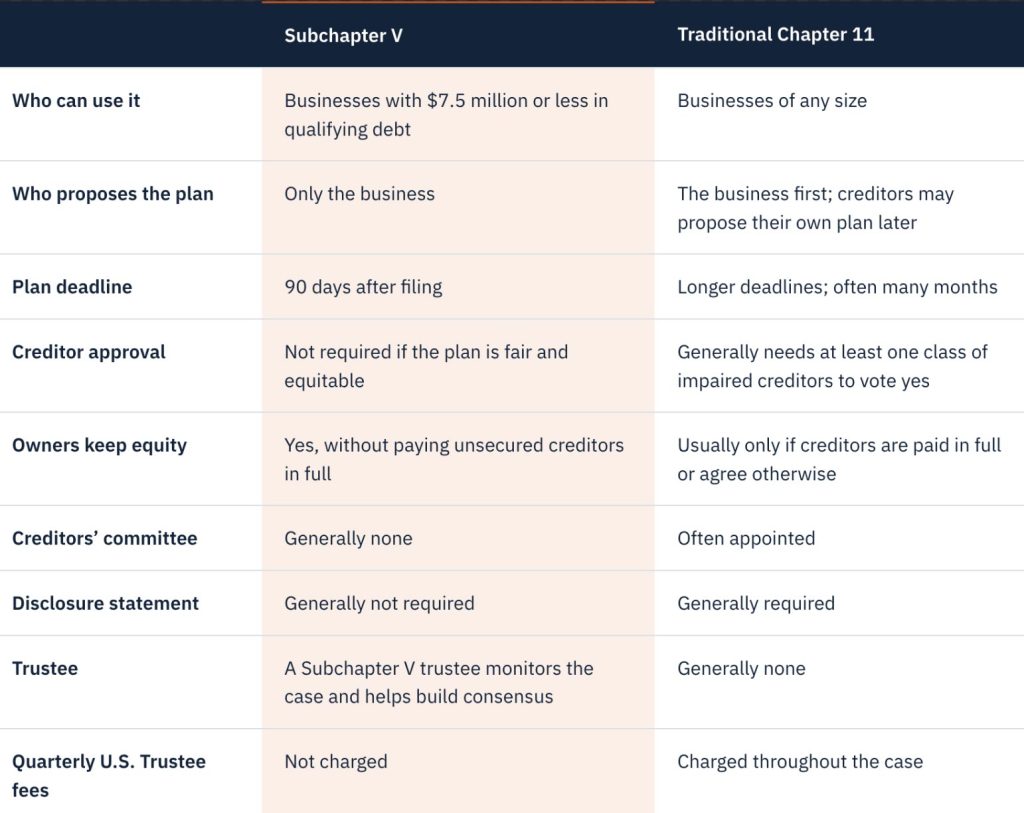
The result is a process that’s typically faster, simpler, and less expensive, with fewer ways for creditors to block a reasonable plan.
When Subchapter V May Be the Right Fit
Subchapter V tends to work best for a business with a viable core that’s been weighed down by debt. It’s often a strong fit when:
- The Business Still Works: The company has steady customers, a workable operation, and enough projected disposable income to fund a payment plan over 3-5 years.
- The Problem Is the Debt, Not the Business Model: If a promising business has an unsustainable capital structure, restructuring the debt can put the company back on solid footing. If it’s losing money at the operating level, a new payment plan alone won’t fix it.
- The Owners Plan to Stay: Many of the differences in the table above, such as keeping ownership without a creditor vote, matter most when the owners intend to keep running the business.
Subchapter V is a powerful section in the Bankruptcy Code that is only afforded to businesses that qualify. For example, the company must be engaged in commercial or business activities, and at least half of its debt must arise from those activities. Businesses whose primary activity is owning a single real estate asset, along with public companies and affiliates of public companies, generally can’t commence a bankruptcy proceeding under Subchapter V.
Other Paths to Small Business Debt Restructuring
Subchapter V isn’t the answer for every distressed business. A traditional Chapter 11 case may be the better route when noncontingent, liquidated debt exceeds the $7.5 million limit even after excluding debt owed to insiders and affiliates. It can also be a better fit when the company has layered financing and/or is facing complex liabilities or disputes, especially when considering that a proposed plan of reorganization in a Subchapter V case must be filed within 90 days of the bankruptcy petition date.
In many cases, the best option is to avoid a bankruptcy filing altogether. Small businesses can often restructure their debt out of court through a forbearance agreement, a loan modification, refinancing, or new terms negotiated directly with key creditors. These approaches are usually faster, cheaper, and more discreet than bankruptcy.
However, for small businesses where outstanding debt is not the only problem, a turnaround plan is crucial for addressing operational issues, with Subchapter V now becoming another tool for more small businesses.
First Steps for Owners Considering Subchapter V
Subchapter V moves quickly once a case is filed, so preparation needs to happen beforehand. If you’re weighing your options, make sure to:
- Get Your Financial Records in Order: A small business filing for Chapter 11 must provide its most recent balance sheet, statement of operations, cash flow statement, and federal tax return. Having accurate, up-to-date financials ready avoids delays.
- Review Your Loan Agreements: Look for defaults, covenant breaches, cross-default provisions, and personal guarantees. These shape your negotiating position, and personal guarantees can leave owners exposed even if the business restructures.
- Identify Critical Vendors and Contracts: Know which suppliers, customers, and leases the business can’t operate without. Bankruptcy gives a business tools to preserve or reject certain leases and contracts, so this list helps shape the plan.
- Budget for the Case: Even a streamlined case has costs, including legal and financial advisory fees and the Subchapter V trustee’s compensation. Build them into your cash projections.
- Explore Out-of-Court Options First: Talk with lenders before positions harden. A negotiated solution with a willing counterparty may make a filing unnecessary.
For more on laying the financial groundwork, including cash flow forecasting and building your advisory team, see our earlier article on the proposed change.
Choosing the Right Path Forward
The permanent $7.5 million debt limit gives many small businesses access to a faster, more affordable way to restructure and keep the business they’ve built. But eligibility is only the starting point. The right path depends on your debt, cash flow, lenders, and goals as an owner.
If your business is under financial pressure, now is the time to understand your options before circumstances limit opportunities for value-maximizing decisions. Let’s talk them through in a free, confidential consultation–contact us today.
This article is for general information only and isn’t legal advice. Speak with qualified bankruptcy counsel about your specific situation.
Authors
Jeff Cope, CTP, CEPA
Sr. Managing Director
JACO Advisory Group
T: 614-582-1797
Jeff Cope has over 30 years of strategic planning, business development, and business transformation leadership experience. Having worked his entire career to implement organizational turnaround and growth for mid-market, closely held, and family-owned businesses, Jeff has a unique understanding of how these enterprises operate and the challenges they face. His experience covers a multitude of industries, with an in-depth understanding of industrial and manufacturing sectors. Jeff is a Certified Turnaround Professional (CTP) by the Turnaround Management Association.
Kyle Arendsen
Senior Associate
Cincinnati
Kyle Arendsen is a member of the firm’s Restructuring & Insolvency Group and focuses his practice on companies and creditors in all aspects of corporate restructurings, including in chapter 11 cases, out-of-court restructurings and cross-border insolvencies. His restructuring matters encompass a wide variety of industries, including aviation, mining, manufacturing, oil and natural gas, healthcare and pharmaceutical. Kyle is a recognized thought leader, and frequent speaker and author, on restructuring and insolvency matters.